Social Technologies and the Future of Work: Unlocking Productivity in 2025
Executive Summary
Social technologies have become integral to how we work in 2025. These tools – from enterprise social networks and messaging platforms to collaborative workspaces – promise to boost productivity by enabling seamless communication and knowledge sharing across organizations. Adoption has surged over the past decade, accelerated by the rise of remote and hybrid work environments. Businesses are investing in these platforms with the expectation of unlocking significant economic value and innovation.
This executive summary distills key findings from JobMesh’s research report on social technologies and the future of work. We find that while social technologies offer enormous potential such as the ability to raise knowledge-worker productivity by up to 25% – many organizations have yet to realize the full benefits . This “productivity paradox” is evident in the disconnect between the ubiquity of digital collaboration tools and the slower-than-expected growth in workplace productivity. The future of work will be defined by how effectively companies bridge this gap. Social technologies are set to play a central role in a more distributed, digital, and collaborative work model, but success requires more than just technology deployment. Companies must also address cultural and organizational challenges, implement best practices, and reengineer workflows to truly unlock productivity gains.
In summary, social technologies are transforming work by connecting employees, breaking down silos, and enabling new ways of working. The companies that pair these tools with strategic change management are improving team performance and innovation. However, those that fail to adapt their culture and processes risk missing out on the promised productivity boost. This report outlines the rise of social technologies, quantifies their economic value, examines the current productivity paradox, explores their role in the future of work, and provides guidance on overcoming challenges to maximize their benefits.
The Rise of Social Technologies
In the span of just a few years, social technologies have evolved from niche applications to core components of business operations. “Social technologies” encompass digital platforms that enable social interaction, collaboration, and user-generated content within a company or across its network. This includes internal communication hubs (like Slack or Microsoft Teams), enterprise social networks for knowledge sharing, project collaboration tools, and integrated forums or wikis. The adoption of these technologies has been remarkably rapid. For example, consumer social media set the stage by reaching widespread use faster than any prior technology – Facebook hit 50 million users in about one year, far quicker than older mediums like television which took over a decade . This rapid consumer adoption created familiarity and demand for similar real-time, interactive communication tools at work.
Within enterprises, the 2010s saw early social platforms (Yammer, Jive, and others) gain traction, but the true inflection point came in the late 2010s and early 2020s. As businesses sought more agile and connected ways of working, tools like Slack revolutionized team messaging, and Microsoft’s acquisition of Yammer and launch of Teams brought social collaboration into the mainstream of corporate IT. The COVID-19 pandemic then dramatically accelerated this rise. Overnight, remote work became the norm for millions, and organizations large and small rushed to implement or expand online collaboration suites. As a result, the use of digital collaboration platforms has soared – Gartner tracked a 44% increase in workers’ use of online collaboration tools since 2019 . By 2025, nearly every knowledge worker regularly uses some form of social technology to communicate with colleagues and coordinate work.
This widespread adoption signifies a fundamental shift in how information flows within companies. Traditional communication channels (such as email and scheduled meetings) are complemented – and in some cases replaced – by real-time chat threads, shared document workspaces, and enterprise social feeds that anyone in the organization can contribute to or search. Teams spread across different locations and time zones can collaborate instantaneously. Decision-making can become more transparent and inclusive as discussions happen in shared digital forums. In essence, companies are transforming into “networked enterprises” where employees are digitally connected in ways that were impossible a generation ago. The rise of social technologies has laid the foundation for more responsive, innovative, and flat organizational structures, aligning with the needs of the modern workforce.
The Economic Value of Social Technologies
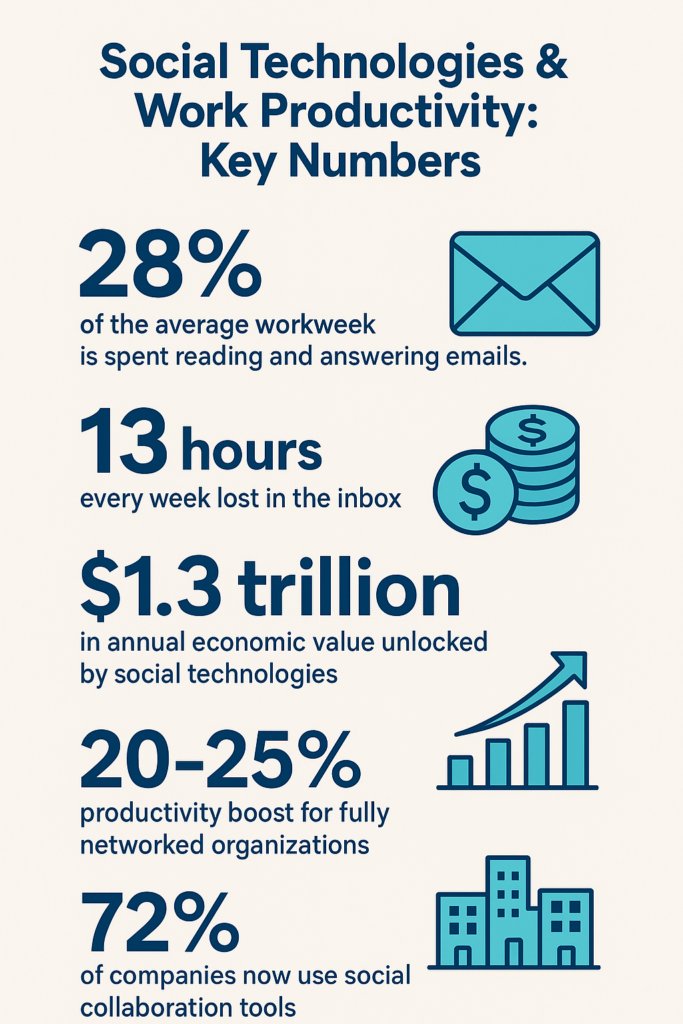
The rationale for embracing social technologies in business is underscored by their significant economic value potential. By improving the speed and quality of communication, these tools help break down silos, reduce duplicated efforts, and enable smarter decision-making. McKinsey Global Institute famously estimated that social technologies could unlock $900 billion to $1.3 trillion in annual value across just four major industry sectors if implemented fully . Two-thirds of this value would come from enhanced collaboration and communication within and across enterprises, reflecting how crucial knowledge-sharing is to organizational performance . In practical terms, companies that effectively use internal social platforms have seen employees spend less time searching for information or following redundant email chains, and more time on productive, value-adding tasks. McKinsey’s research suggests that using social technologies to improve internal collaboration can raise the productivity of knowledge workers by 20% to 25% .
Beyond direct productivity gains, the collaborative culture fostered by social technologies drives innovation and employee engagement. When information flows freely, employees at all levels can contribute ideas and insights. For example, an engineer in one office can swiftly share a solution to a problem that a colleague on another continent is facing, via an enterprise social network or team forum. Such real-time knowledge transfer can shorten project cycles and spur creative problem-solving. Research has found that businesses promoting collaborative, connected ways of working are substantially more likely to be high-performing. One study by the Institute for Corporate Productivity found that companies with strong collaborative cultures were five times more likely to be high-performing organizations. Conversely, lack of collaboration is costly: in a survey, 86% of employees and executives blamed ineffective communication or teamwork for workplace failures .
Effective use of social technologies also yields financial returns through improved customer engagement and faster innovation. Marketing and product development teams, for instance, can leverage social platforms to crowdsource ideas internally or get rapid feedback from cross-functional colleagues, accelerating time-to-market for new products. Some organizations extend their enterprise social tools to include partners and customers in certain projects, further multiplying the value creation opportunities. In sales and customer service, internal social channels allow front-line employees to quickly tap collective expertise to resolve customer issues, leading to higher satisfaction and potentially increased revenue. All of these improvements contribute to economic value – through higher productivity, higher quality outputs, and cost savings (for example, by reducing the need for meetings, travel, or rework).
However, capturing this value is not automatic. Studies stress that companies only reap the full economic benefits of social technologies when they pair tool adoption with process changes and a supportive culture. The technology’s potential is clear: when teams communicate seamlessly and knowledge is readily accessible, it translates into tangible performance gains. Well-connected teams have been shown to achieve project goals more efficiently and with better outcomes. In fact, teams that communicate effectively have been observed to increase their productivity by as much as 25% . The business case for social technologies is therefore compelling – not only do they promise efficiency and cost improvements, but they also build organizational resilience by fostering a more informed and engaged workforce.
The Productivity Paradox: Promise vs. Reality
Despite the clear potential and widespread deployment of social collaboration tools, many organizations have experienced a “productivity paradox” – the anticipated productivity boom from technology has, in many cases, not fully materialized. Economists and business leaders have noted an intriguing trend over the past two decades: even as advanced technologies proliferated in the workplace (from high-speed internet to smartphones to enterprise software), broad measures of productivity growth remained surprisingly sluggish . In the United States and other developed economies, productivity growth since the mid-2000s has generally fallen short of expectations, confounding early optimism that digital tools would inevitably usher in rapid gains. As one observer pointed out, we have gained “an armada of supercharged workplace tools, and yet we’re not getting much more done” .
There are several explanations for why social technologies’ promise hasn’t yet translated into dramatic productivity increases across the board. One major factor is adoption quality. It’s not enough to simply roll out a new platform – how people use it matters enormously. In many companies, employees stick to old habits of communication (like email or working in silos) even when new, more efficient tools are available. Organizational inertia and comfort with the status quo can blunt the impact of innovative technologies. As the saying goes, old habits die hard: many organizations still rely on the traditional mix of email, meetings, and phone calls, and employees may be reluctant to fully embrace new collaborative practices . The result is that expensive new tools sometimes end up underutilized or misused – for example, a team might adopt a chat platform but continue to rely on endless email threads out of habit, or they might use the platform in a way that creates noise and distraction rather than clarity.
This leads to another aspect of the productivity paradox: the issue of digital overload and new distractions. While social collaboration apps aim to streamline work, they can also unintentionally introduce always-on communication pressures. The ease of sending a message to a coworker or posting in a group space can lead to notification overload and constant interruptions in workflow. Without proper norms, employees might find themselves inundated with chat pings and discussion threads, fragmenting their focus. In effect, some of the time saved by faster communication can be lost again due to these new forms of interruption and multitasking. Studies have noted that the benefits of faster communication can be undermined if workers end up “checking our in-boxes constantly” or juggling too many messaging channels . Indeed, ineffective use of the tools can hamper productivity – for instance, a third of workplace communicators report being unhappy with the communication channels their company provides as of 2025 , suggesting that simply having collaboration software isn’t a silver bullet.
Another challenge is that realizing gains from social technology often requires deeper organizational change that takes time. Installing a platform is relatively easy; transforming workflows and company culture is hard. Many organizations are still learning how to redesign processes around open information sharing and how to train their workforce to make the most of new tools. There can be a lag between technology investment and measurable productivity outcomes, especially if initial implementation is patchy. Additionally, some improvements enabled by social technologies – such as better knowledge retention, higher engagement, or more innovation – while valuable, may not immediately show up in quarterly productivity metrics. It’s possible we are in an adjustment period akin to the 1980s “computer paradox” era, and that the biggest gains from today’s collaborative tools will surface once organizations fully adapt their structures and practices to leverage them.
It is also worth noting that not all uses of social tools yield productive outcomes. Without guidelines, employees might use enterprise social platforms for non-work-related chatter or socializing that, while building camaraderie, might not translate into performance improvement. There is a risk of information clutter – important knowledge can be buried in a flood of casual messages if the platform isn’t organized well. Moreover, concerns about privacy and security can limit how freely information is shared. For example, workers might hesitate to post candid insights or data on a company-wide forum if they worry about confidentiality or management scrutiny. These nuances help explain why the road to unlocking productivity has been complex. The paradox, in summary, is that the tools to enable unprecedented productivity and collaboration are here, yet many companies have not seen a commensurate jump in output. Recognizing this gap is the first step toward closing it.
Social Technologies and the Future of Work
Looking ahead, social technologies are poised to be linchpins of the future of work, shaping how and where work gets done. The year 2025 finds organizations operating in environments that are more digital, distributed, and dynamic than ever before. Hybrid work – with employees alternating between remote and office – has become a standard practice for many companies. Approximately half of U.S. employees now hold jobs that are “remote-capable,” meaning they can work off-site at least part of the time . To manage this dispersed workforce, firms are relying on digital tools to serve as a virtual office. Platforms like Microsoft Teams (which surpassed 300 million active users) and Slack have effectively become the “digital headquarters” for numerous businesses, where colleagues chat, meet, brainstorm, and even socialize. In this context, social technologies are not just tools but the very infrastructure of work.
One key trend is the normalization of asynchronous collaboration. Because teams are often spread across time zones or juggling flexible schedules, social technologies that allow people to contribute on their own time – such as discussion boards, shared document platforms, or project management boards – are increasingly important. Workers might brainstorm ideas in a persistent chat channel or update a shared project Kanban board throughout the day, rather than holding a single synchronous meeting. This flexibility can improve work-life balance while maintaining productivity, as employees are empowered to communicate when they are most effective. It also means that knowledge is documented (in chat histories, wiki pages, etc.) and can be accessed by others at any time, creating an ongoing knowledge repository for the organization.
Furthermore, the future workplace will be more interwoven with intelligent technologies, and social collaboration tools are evolving accordingly. Artificial intelligence is being integrated into these platforms to enhance their utility – for example, AI-driven assistants can automatically transcribe meetings, suggest relevant documents in a conversation, or summarize long discussion threads. These features aim to reduce information overload and help workers focus on high-value tasks. For instance, if an employee misses a lengthy chat discussion, an AI summary might catch them up in seconds, or if someone is looking for an expert on a topic, AI might analyze network interactions to recommend a colleague with the right expertise. This convergence of social platforms with AI is creating a smarter collaborative environment, which could finally deliver some of the long-awaited productivity boosts by handling routine communication tasks and surfacing important information.
Another aspect of the future of work is the changing workforce demographics and expectations. Younger employees (Millennials and Gen Z), who make up a growing portion of the labor force, are digital natives comfortable with communicating through social media, texting, and collaborative apps. They tend to expect consumer-grade technology experiences on the job. In practice, this means companies aiming to attract and retain top talent need to provide modern collaboration tools and a culture of openness. Rigid email chains and top-down communication are giving way to more transparent, networked interaction styles that these workers prefer. This generational shift further cements the role of social technologies in the workplace – tools that enable quick feedback, peer recognition, and a sense of community align well with the values of the emerging workforce.
Crucially, social technologies are also redefining organizational structures. The classic siloed hierarchy is being complemented by fluid networks of teams. It’s now common for employees to be part of multiple project groups simultaneously, and for cross-functional teams to assemble quickly to tackle specific challenges. Collaboration platforms facilitate this agility by making it easier for ad-hoc teams to form, communicate, and disband when projects are done. In essence, the future of work is more project-oriented and collaborative. Knowledge and expertise can be drawn from anywhere in the organization on demand. We see companies experimenting with internal “talent marketplaces” and communities of practice, enabled by social tools that let employees showcase their skills and join conversations beyond their immediate job roles. All these developments point to a future in which social technologies aren’t just supporting work – they are the backbone of how work is organized.
However, it’s also clear that human factors remain paramount. The most advanced tools will not replace the need for effective leadership and empathetic management. In fact, leaders of the future must excel at leveraging these technologies to foster inclusion and engagement. A manager in 2025 might host an interactive Q&A on the company’s internal social network to maintain transparency, or recognize a team’s success via a public post that reaches the entire organization. Such practices can boost morale and create a shared culture even when employees are physically apart. The future of work, therefore, is a blend of high-tech and “high-touch” – using social technology to strengthen human connections and align everyone towards common goals, regardless of where they are working from.
Challenges and Best Practices for Implementation
While the benefits of social technologies are compelling, implementing them successfully comes with challenges. Organizations often encounter hurdles such as cultural resistance, unclear usage guidelines, and concerns about information security or information overload. Below, we outline some key challenges and best practices to address them, based on insights from our research:
- Challenge: Cultural Resistance and Adoption Gaps. Employees may be hesitant to change long-established ways of working. Some may view new collaboration platforms as extra work or be unsure of how open to be on them. In other cases, senior leaders might not actively use the tools, sending a signal that participation is not required. Best Practice: Secure leadership buy-in and model the desired behavior. When executives and managers actively use social platforms to communicate (for example, sharing updates or soliciting ideas), it legitimizes the tools and encourages others to engage. Provide training and change management that highlights success stories to demonstrate how these tools can make work easier. It’s crucial to create a safe, inclusive environment on the platform – one where all employees feel their contributions are welcomed, regardless of rank. Over time, as people see real value (like problems solved faster or recognition gained through the platform), reluctance tends to fade.
- Challenge: “Always-On” Syndrome and Information Overload. With group chats, comment threads, and constant notifications, employees can easily feel overwhelmed. The blurring of work-life boundaries due to always-on communication can lead to burnout. Best Practice: Establish clear norms and smart workflows for tool usage. This might include guidelines on which channel to use for what purpose (to avoid important information getting lost in chat), expected response times (so people know they don’t have to be online 24/7), and encouraging use of features like status indicators or “do not disturb” modes. Encourage teams to periodically cleanse or archive old channels and to use tagging and search functions to keep information organized. Some companies institute “focus time” policies where no messages are sent during certain hours to allow deep work. Educating employees on how to manage notifications and curate their information streams can significantly mitigate overload. When implemented thoughtfully, social technologies should streamline work, not complicate it.
- Challenge: Fragmentation and Tool Proliferation. In the rush to adopt the latest apps, organizations sometimes end up with multiple overlapping tools (for instance, two different chat applications used by different departments), which can fracture communication and impede efficiency. Best Practice: Strive for integration and consolidation. It’s generally better to pick a primary suite of tools and integrate systems (e.g., link the chat platform with the project management system and the company intranet) so that information flows are centralized. Having a “single source of truth” for certain types of knowledge (a central wiki or knowledge base, for example) helps avoid confusion. IT and business leaders should periodically review the collaboration toolset in use and eliminate redundancies. Providing a well-integrated, user-friendly platform reduces the temptation for teams to stray to unofficial tools.
- Challenge: Measuring ROI and Value. Some leaders struggle to see the tangible return on investment from social technologies. Unlike a piece of manufacturing equipment, collaboration software benefits are indirect and can be hard to quantify, leading to skepticism in budget decisions or continued support. Best Practice: Define clear objectives for what the tools are meant to achieve – such as reducing project turnaround time, improving employee engagement scores, or decreasing email volume – and track metrics around those goals. Many platforms provide analytics (like active usage rates, content contribution levels, or network connectivity maps) that serve as proxies for engagement and knowledge flow. Supplement these with qualitative feedback from employees about how the tools have helped them in their jobs. Over time, try to link improvements (e.g., faster problem resolution or higher customer satisfaction) to the use of the collaboration platform where possible. By building a case with data and anecdotes, organizations can demonstrate value to stakeholders. Remember that some benefits, like preserving organizational knowledge or enabling flexibility, will show their worth in the long run – for example, in how quickly a company can respond to change or innovate in a crisis.
- Challenge: Security and Governance Concerns. Opening up internal discussions and file sharing via social tools raises valid concerns about data security, privacy, and regulatory compliance. Companies worry about sensitive information leaking or inappropriate content being shared. Best Practice: Implement robust governance frameworks for your social technologies. This includes setting permissions and access controls (who can see or post what), utilizing encryption and security features offered by enterprise-grade platforms, and enabling moderation or auditing capabilities for content. Establish clear policies on acceptable use – what can and cannot be shared on the platform – and ensure all employees are aware of these rules. Many organizations conduct regular training on data security specifically in the context of collaboration tools. It’s also wise to leverage software that allows IT oversight, such as audit logs or data-loss prevention settings. While there are risks (such as the possibility of employees spending excessive time chatting about non-work topics ), these can be mitigated with the right controls and a culture of trust. Indeed, research indicates that the benefits of social technologies will likely outweigh the risks for most companies, provided there is proper understanding and oversight .
By addressing these challenges with proactive strategies, companies can significantly increase the likelihood of successful social technology implementation. Ultimately, the common thread in these best practices is thoughtful change management: aligning technology use with business goals and human behavior. It often comes down to the classic trio of people, process, and technology – in the case of social tools, all three must come together. Organizations that manage this alignment report smoother collaboration, faster problem-solving, and even unforeseen benefits like improved onboarding (as new hires ramp up faster by accessing the knowledge base on social platforms) and stronger cross-team relationships. The journey can be complex, but the outcome is a more connected and adaptable organization.
Conclusion
Social technologies have undeniably moved to the center stage of work life by 2025. Their ability to connect employees across geographies and functions in real time, create shared knowledge repositories, and enable new collaborative workflows marks a profound change in how work gets done. As outlined in this executive summary, the potential gains – from higher productivity and innovation to a more engaged workforce – are too significant to ignore. Yet, the experience of the past decade also teaches us that technology alone is not a panacea. To truly unlock the productivity promised by these tools, companies must pair adoption with adaptation. This means nurturing a culture that values transparency and knowledge sharing, training workers to embrace new communication norms, and continuously refining processes to avoid the pitfalls of digital overload or misuse.
The future of work is being written through the interplay of social technology and human collaboration. On one hand, we have more advanced platforms and AI-driven capabilities at our disposal than ever before; on the other, success still hinges on timeless organizational skills – effective leadership, trust, and the ability to manage change. Companies that strike the right balance are already seeing a payoff: more agile operations, better talent retention, and improved business outcomes. These organizations treat social technology not as a mere IT deployment, but as a strategic asset intertwined with their mission and way of working. They encourage experimentation, learn from setbacks, and remain flexible as new tools and practices emerge, understanding that it’s an ongoing evolution.
For businesses that have lagged, it is not too late to course-correct. The year 2025 is a pivotal moment: the tools are mature, the workforce is ready, and the competitive advantages of a connected organization are increasingly clear. Enterprises that fail to leverage social technologies effectively risk falling behind more networked competitors and missing out on the creativity and efficiency of a digitally fluent workforce. In contrast, those that invest in both the technology and the requisite cultural evolution stand to unlock the true productivity gains that have long been envisioned. In closing, the evidence is clear that social technologies, when embraced holistically, are key to unlocking productivity in the modern era. The onus is now on organizations to execute on this insight – turning potential into performance, and connecting people to drive the future of work forward.
Sources
- McKinsey Global Institute – The Social Economy: Unlocking Value and Productivity through Social Technologies (2012)
- McKinsey & Company – Capturing Business Value with Social Technologies (2012)
- Cal Newport – Solving the Productivity Paradox, The New Yorker (2023)
- Reworked – How Do We Resolve the Productivity Paradox? (2022)
- Institute for Corporate Productivity – Collaboration and High-Performance Culture (2017)
- Gartner – Research on Collaboration Tool Usage Increase (2021)
- Pumble – Workplace Communication Statistics 2025 (2025)
- Runn – Collaboration Counts: Teamwork Statistics for 2025 (2024)